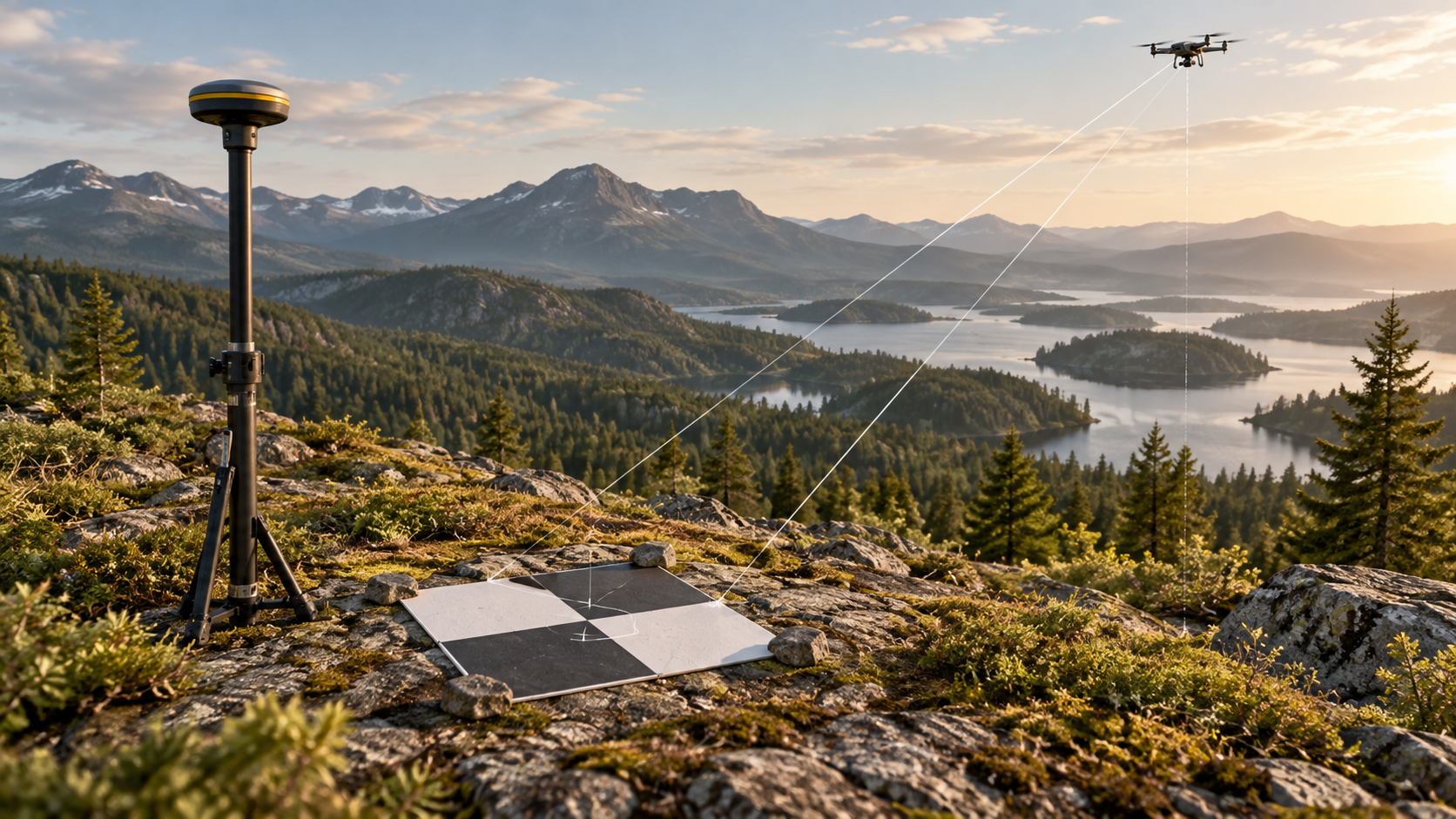
RTK and PPK workflows improve estimates of camera position by using correction data. They can reduce reliance on numerous control points, but they do not remove every error source.
Verify the position solution
Retain base or network details, correction status, antenna offsets, timestamps, coordinate reference, height reference, and processing report. Fixed does not mean every image is correct.
Keep checkpoints
Independent checkpoints remain valuable for testing horizontal and vertical results. Distribute them across the site and do not use them to fit the model.
Watch systematic errors
Incorrect antenna height, datum transformation, geoid handling, lever-arm assumptions, time synchronization, or camera calibration can shift a precise-looking dataset.
MapFocal records the processing mode and evidence, but the operator remains responsible for the reference-system chain and accuracy statement.
Understand the positioning chain
RTK applies corrections during the flight, while PPK applies them afterward using logged observations. Both depend on satellite geometry, correction quality, antenna calibration, time synchronization, lever-arm handling, base coordinates, and reference frames. A “fixed” status is useful evidence, not a complete accuracy statement.
Preserve the raw record
Retain rover and base observations, correction source, flight logs, camera event marks, processing report, base position method, CRS, vertical reference, geoid model, and quality flags. Without those records, it is difficult to diagnose a later offset or reprocess against an improved base coordinate.
Use control according to risk
Direct georeferencing can reduce ground-control effort, but independent checkpoints remain valuable. For high-consequence work, compare camera-position residuals, control/checkpoint errors, and stable known features. A systematic vertical error can remain even when relative geometry looks excellent.
Common failure modes
Watch for float solutions, correction dropouts, wrong antenna height, mismatched epochs, base coordinates copied in another datum, geoid/ellipsoid confusion, and image-event timing offsets. Plot quality by exposure rather than relying on a mission-wide label.
Report what was corrected, what was independently checked, the reference systems used, error statistics, exclusions, and limitations. Avoid translating centimetre-level camera coordinates directly into a blanket claim for every surface pixel.
Example positioning investigation
A flight reports fixed RTK for most exposures but loses corrections near one boundary. Rather than labeling the whole mission “RTK accurate,” the operator plots quality by image, preserves raw observations, and reviews checkpoint errors across the site. A vertical offset shared by all checkpoints leads to a check of geoid handling and base-coordinate reference.
The corrected workflow records antenna calibration, base method, correction source, event timing, processing software, reference frames, and exclusions. The affected boundary receives extra scrutiny in the reconstruction.
This evidence distinguishes precise relative camera positions from validated final products. It also means a later operator can reprocess the observations if base coordinates or transformation grids are improved.
Sign-off record
Before relying on the workflow, record the project and revision, source dataset, selected preset or method, coordinate and height references, units, processing version, warnings, exclusions, independent validation, and the artifact used for the decision. Reopen critical outputs in an independent viewer and keep their checksums with the report.
The reviewer should answer four questions in writing: Is the required area supported by source evidence? Does the chosen product actually answer the operational question? Are accuracy and limitations stated without inferring more than the checks prove? Can another person reproduce the result from the retained inputs and settings?
If any answer is no, hold the delivery or label the limitation. A documented stop is safer than a polished output whose assumptions cannot be recovered.